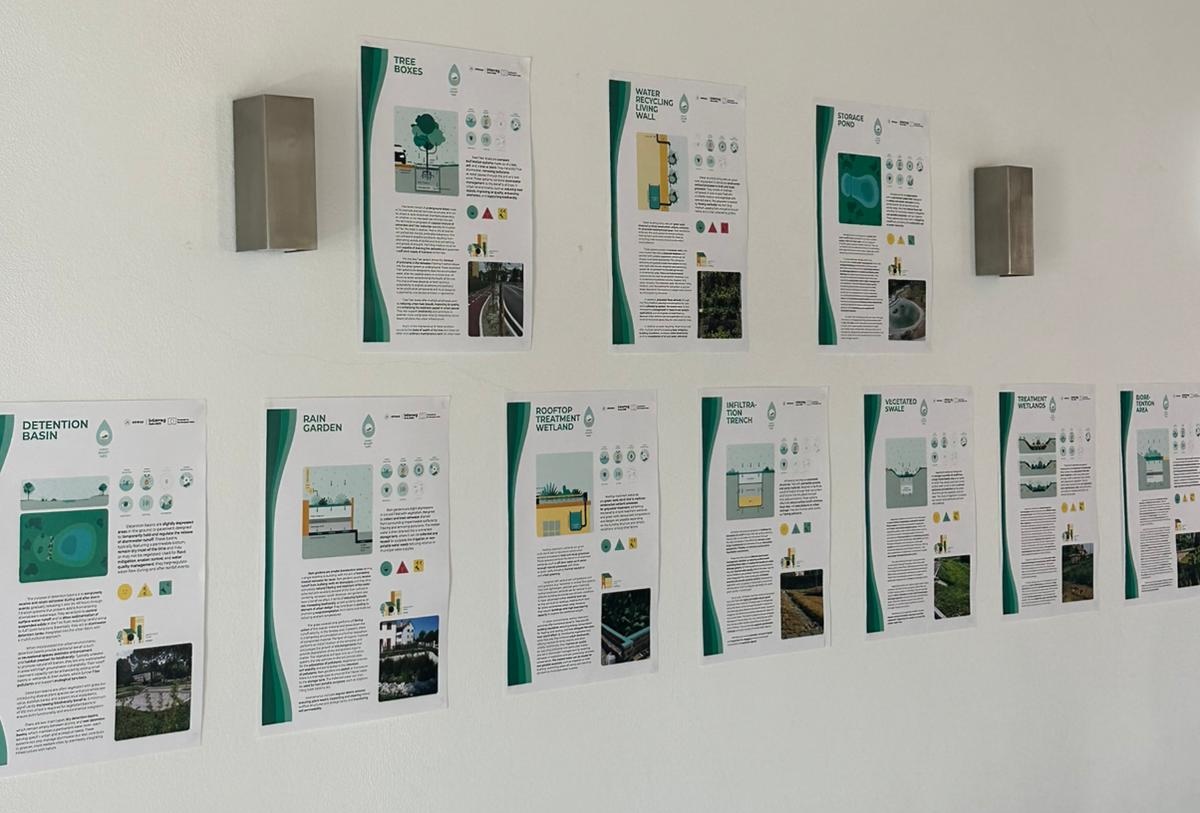
the URWAN Catalogue Sheets support cities in choosing and implementing effective Nature-based Solutions.
The picturesque town of Cuba, Portugal, hosted the second Living Lab of the URWAN – Urban Regenerative Water Avant-garde(N) project, bringing together local authorities, urban planners, technical experts, and community stakeholders from across the Euro‑Mediterranean region. Organised within the framework of the Interreg Euro‑MED Programme, the event provided an immersive and collaborative space to address the persistent barriers to implementing Nature‑based Solutions (NbS) for sustainable water management and urban regeneration.
Held on 1 – 2 July 2025, the Living Lab built upon the outcomes of URWAN’s first Living Lab, moving a step further by focusing on the legal, governance, and technical challenges that still hinder the mainstreaming of NbS in urban contexts. The initiative reaffirmed URWAN’s commitment to supporting cities in their transition towards more resilient, inclusive, and climate‑adaptive urban systems.
Designed as a hands‑on and participatory experience, the Living Lab fostered collaboration, peer learning, and innovation among diverse stakeholders. The event opened with an overview of the URWAN project and its objectives, setting the scene for a series of practical workshops aimed at tackling real‑world implementation challenges.
Day 1 featured roundtables and thematic presentations from pilot cities and technical experts, who shared concrete experiences and strategies for overcoming institutional, regulatory, and operational constraints. These discussions evolved into collaborative solution‑mapping sessions, encouraging participants to identify scalable and context‑sensitive approaches to embedding NbS into local urban planning and water governance frameworks.
On Day 2, the focus shifted decisively towards action. Through interactive working sessions, participants examined four case studies, identifying specific local challenges and co‑developing a joint analytical framework. A key highlight of the day was the study visit to the UNESCO Centre in Beja, where participants explored how integrated NbS approaches are already contributing to sustainable water governance and territorial resilience in the region.
Beyond technical exchange, the second URWAN Living Lab served as a catalyst for long‑term collaboration. By the end of the event, municipal representatives and urban practitioners had not only gained practical tools and actionable insights, but also strengthened mutual trust and cooperation across borders. Importantly, they became part of a growing Euro‑Mediterranean network of change agents committed to transforming cities into more resilient, socially inclusive, and environmentally sound environments.
From the perspective of ANCI Lazio, Lead Partner of the URWAN project, the Living Labs represent a core instrument for bridging policy, practice, and innovation. They are not stand‑alone events, but strategic stepping stones towards a shared long‑term vision: the mainstreaming of water‑related NbS across the Euro‑MED region as key drivers of climate adaptation, social equity, and economic efficiency.
Through initiatives like the Living Labs, URWAN continues to support cities in translating European ambitions on sustainability into locally grounded, actionable solutions, reinforcing the role of municipalities as protagonists of the green and regenerative transition.