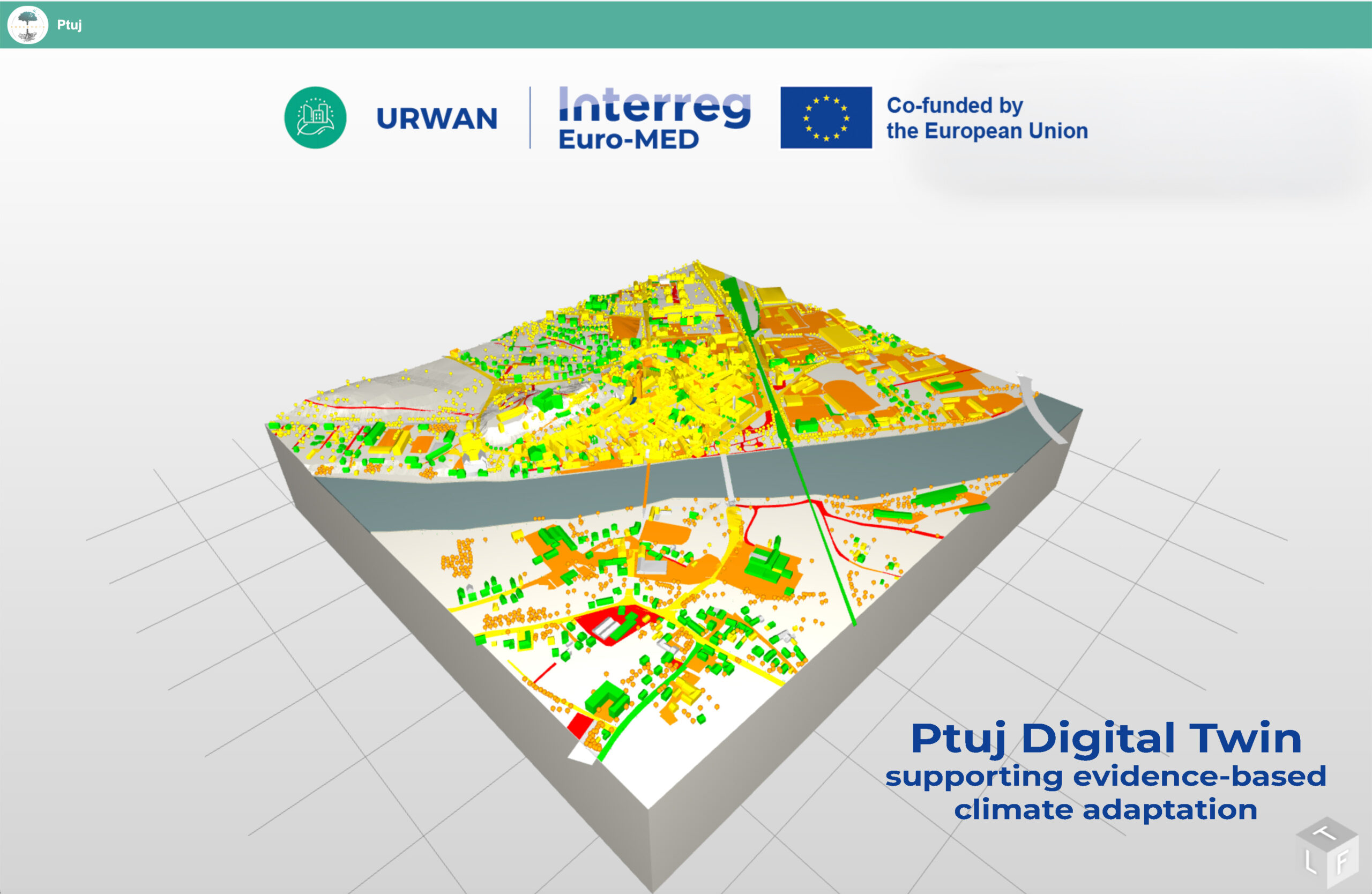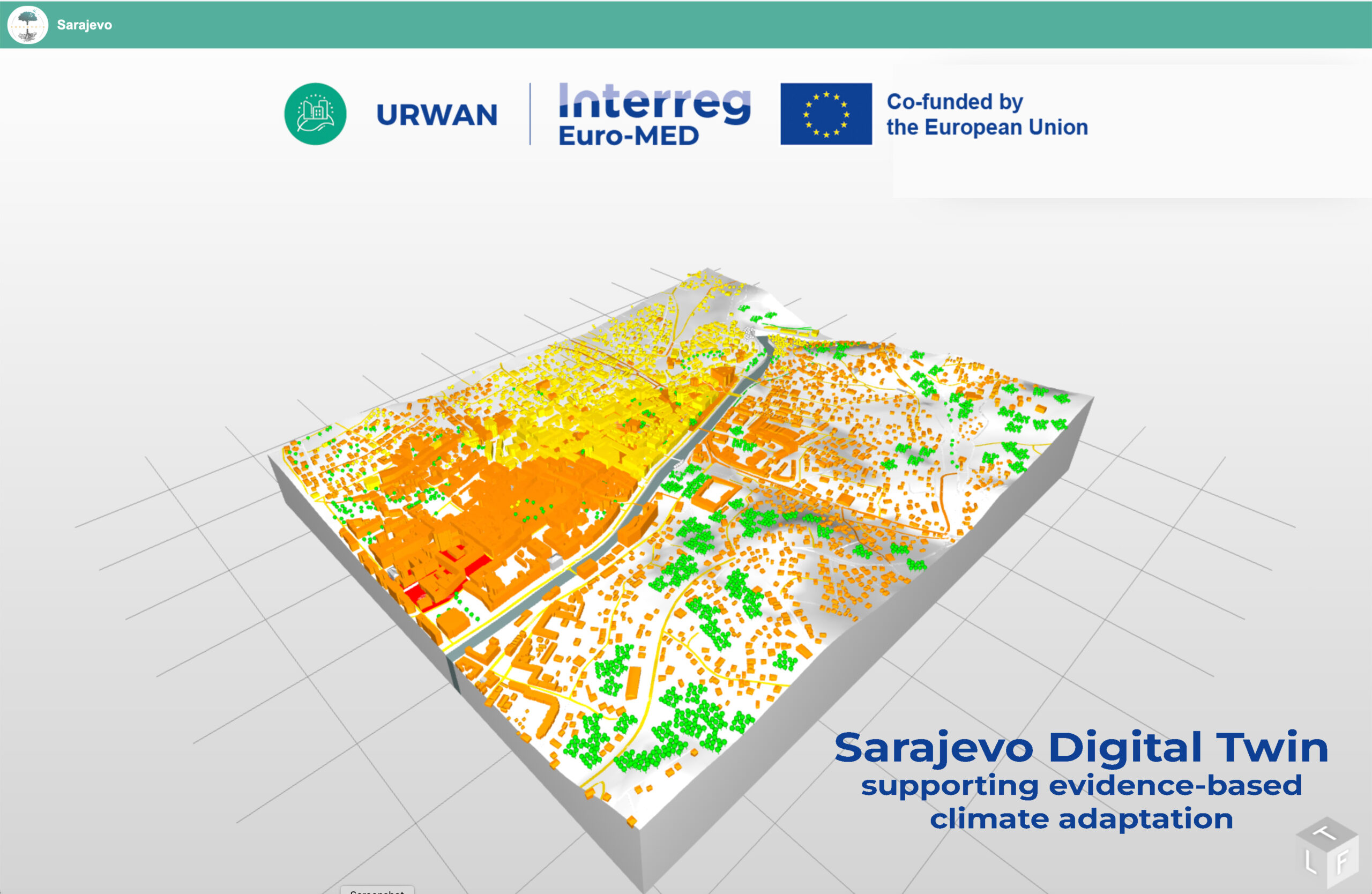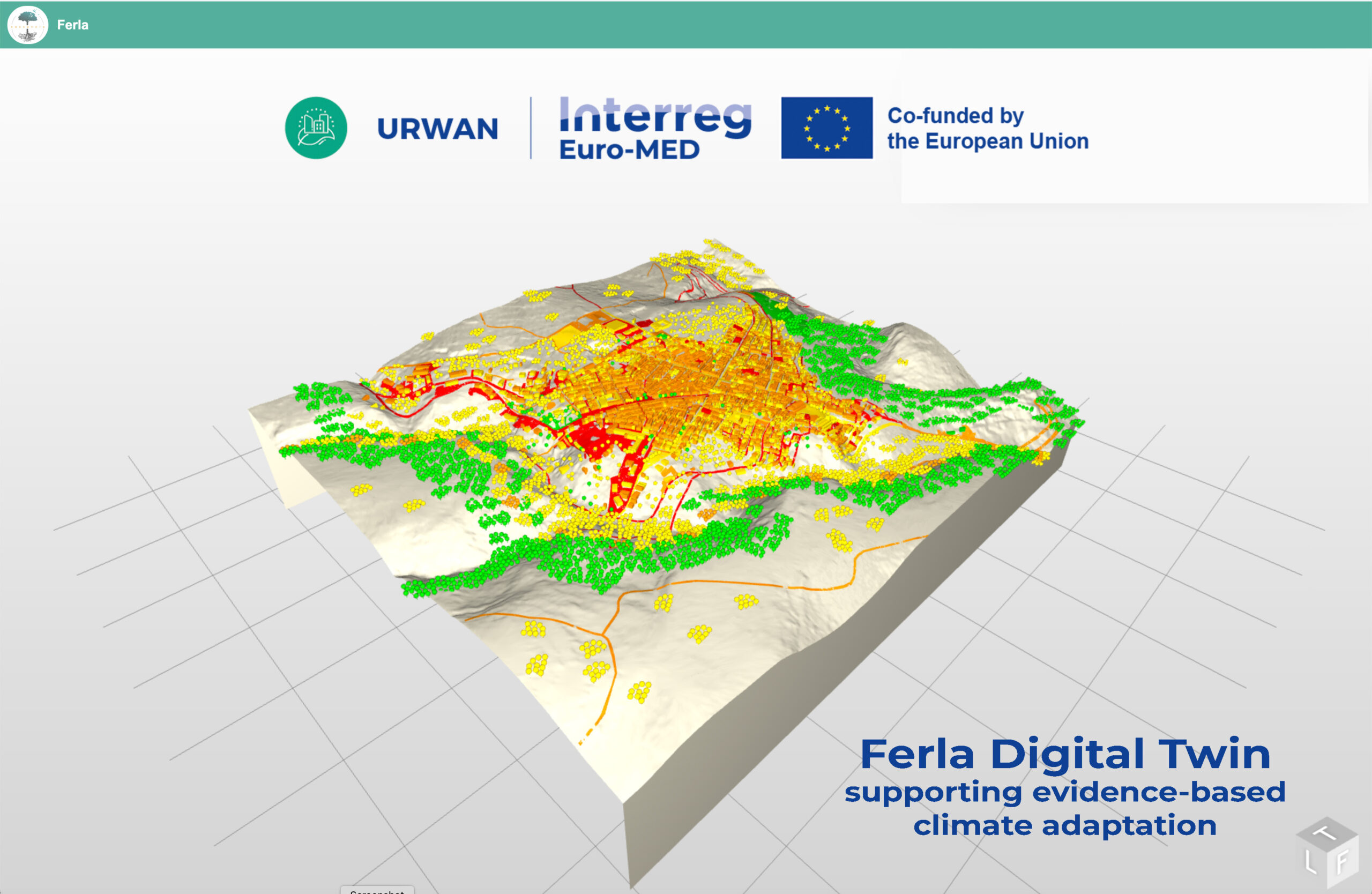

How can a city prepare for heatwaves, droughts and floods before they happen? This is one of the key questions addressed by URWAN – Urban Regenerative Water Avant-garde(N). To tackle it, SVI.MED. – EuroMediterranean Centre for the Sustainable Development, the project partner responsible for this activity, involved the company Kassandra project to apply its Integrated Decision Support System (IDSS) to the three cities involved in the project – Ptuj (Slovenia), Ferla (Italy) and Sarajevo (Bosnia and Herzegovina) – and to develop a digital twin of each selected area, supporting the cities in their climate adaptation planning with solid data rather than guesswork.
At the heart of the system are the “digital twins” of the three pilot cities: detailed 3D replicas that bring together maps, territorial data and environmental information into a single virtual model. Think of them as a testing ground where different interventions can be tried out on screen before a single euro is spent on the ground. Connected to Kassandra’s resilience engine, each model measures how well a city can withstand climate stress – expressing it through a dedicated metric, the Kassandra Resilience Index – and compares alternative strategies, so that planners can see which solution works best. To make all this usable beyond technical experts, an interactive Web Viewer was created for each city: an intuitive online interface where partners, local authorities and citizens can explore the model, read the resilience indicators and compare future scenarios. Watch the videos here.
The system also places nature at the centre of the response. Indeed, the URWAN NbS Catalogue has been turned into an operational tool, the Kassandra NBS Parametric Tile Library. Within it, each solution becomes a “building block” (a parametric tile) carrying both its environmental performance and its real costs, from construction to maintenance over its whole lifecycle. A companion tool, the interactive NBS Tile Cost Calculator, lets an administration assemble its own scenario, choosing solutions and quantities, and instantly estimate the gain in resilience, the investment required and the time needed to recover it – always compared with conventional “grey” infrastructure made of concrete and pipes.
For the communities of Ferla, Ptuj and Sarajevo, the value of these tools is very tangible. They give local administrations – often small and with limited resources – the means to make transparent, evidence-based choices, to prioritise the investments that protect people and places most effectively, and to build a stronger case for green rather than grey solutions. In this way, URWAN turns climate adaptation from an abstract challenge into a set of decisions that territories can actually take – and share with the people who live there.
This work is part of the URWAN Enabler Pack. To learn more about each city, visit the dedicated section in the URWAN website.